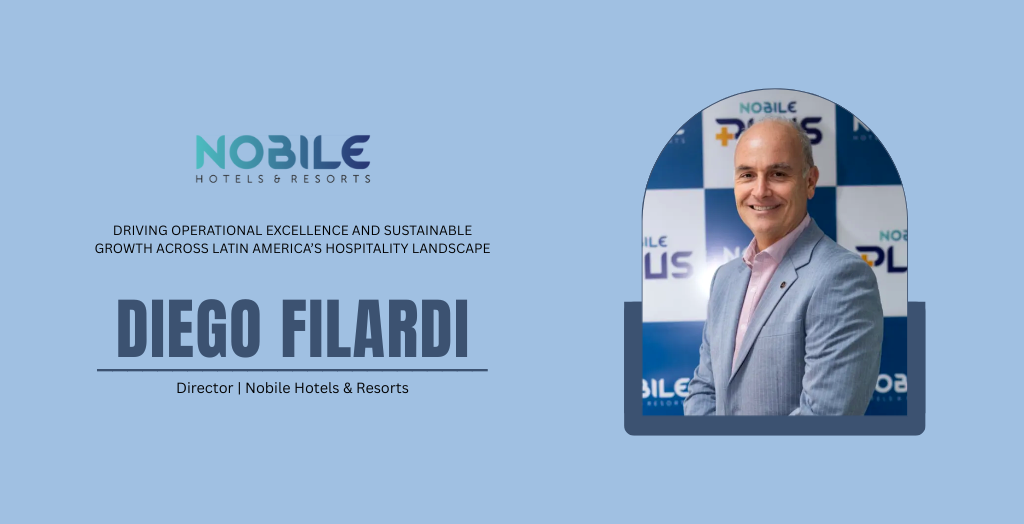
In Latin America’s hospitality sector—where volatility, fragmented ownership, and uneven professionalization remain constant challenges—sustainable success is rarely driven by bold ideas alone. It is built through disciplined execution, market sensitivity, and the ability to translate strategy into daily operations. Few companies understand this reality as clearly as Nobile Hotels & Resorts, a hotel management group that has steadily positioned itself as a reference operator for independent hotels across the region.
Founded in 2008, Nobile has grown by focusing on a clear niche: supporting hotel owners who seek professional management, operational structure, and commercial intelligence—without losing their property’s identity. Central to this evolution has been the strategic leadership of Diego Filardi, Director at Nobile Hotels & Resorts, whose three-decade career across multiple Latin American markets has shaped the company’s operational mindset and long-term vision.
Rather than pursuing aggressive expansion or short-term gains, Nobile’s growth has been guided by a pragmatic philosophy: sustainable hospitality is built through consistency, people, and systems that work under real market conditions.
A Leadership Foundation Built on Operations
The leadership approach that defines Nobile Hotels & Resorts today is deeply influenced by Filardi’s professional background. His career began long before automation, revenue management systems, and real-time dashboards became standard industry tools. Starting in sales, he learned hospitality through direct human interaction—negotiation, presence, and relationship-building—what he often refers to as his “street university.”
That early exposure shaped a leadership style grounded in reality rather than theory. As his career progressed into operational and executive roles across Chile, Argentina, Paraguay, Mexico, Peru, El Salvador, and other markets, a consistent pattern emerged: hotels succeed when operations are respected, teams are empowered, and decisions are aligned with long-term objectives.
This philosophy became a natural fit for Nobile Hotels & Resorts, a company whose operational DNA values structure without rigidity and adaptability without improvisation. From the outset, the alignment between leadership vision and organizational culture allowed Nobile to strengthen its positioning as a disciplined yet flexible operator.
Nobile Hotels & Resorts: A Business Model Built for Latin America
What differentiates Nobile in a crowded hospitality landscape is not scale alone, but how it scales. The company operates across multiple business models, adapting to different ownership structures while maintaining a consistent operational framework. This adaptability has been particularly effective in Latin America, where independent hotels dominate many markets and require tailored solutions rather than standardized templates.
Nobile’s role often begins by diagnosing operational inefficiencies, commercial blind spots, and cost structures that limit profitability. From there, the company implements structured processes, performance indicators, and commercial strategies designed to stabilize operations and unlock value—without disrupting the hotel’s local character.
Today, Nobile maintains a strong presence in Paraguay, Chile, and Uruguay, with continued expansion in Uruguay and strategic growth planned for Peru and Argentina. A particular focus has been placed on secondary cities and emerging destinations, where demand fundamentals are strong but professional hotel management is still developing.
This measured expansion strategy reflects a core belief within the organization: growth must be sustainable, profitable, and supported by capable local teams.
From Individual Leadership to Organizational Culture
While strong leadership has played a critical role in Nobile’s trajectory, the company’s success is ultimately rooted in its people. Over time, leadership within the organization has evolved from direct execution to facilitation—creating structures that allow teams to perform autonomously while remaining aligned with strategic goals.
Rather than centralized control, Nobile emphasizes clarity: clear expectations, clear metrics, and clear accountability. Teams are encouraged to take ownership of results, supported by data-driven decision-making and transparent communication.
This approach has proven especially effective in high-pressure operational environments, where uncertainty is common. By fostering trust, promoting proactivity, and recognizing both results and attitudes, Nobile has cultivated a culture where continuous improvement is embedded into daily operations.
Mistakes are treated as learning opportunities, while inaction is discouraged. The result is an organization capable of adapting quickly without losing control—a critical advantage in a constantly evolving hospitality landscape.
Operational Excellence as a Financial Strategy
At Nobile Hotels & Resorts, operational excellence is not viewed as a cost center, but as a financial strategy. Well-designed operations reduce waste, improve consistency, and directly enhance guest satisfaction—factors that translate into stronger financial performance over time.
Key operational pillars include:
1. Process discipline and standardization where it adds value
2. Rigorous cost control aligned with service quality
3. Clear performance indicators across departments
4. Daily commercial and market analysis
When teams understand how their actions impact both guest experience and profitability, alignment occurs naturally. This integration between operations and finance has allowed Nobile to stabilize underperforming assets, improve forecasting accuracy, and drive sustainable revenue growth.
Technology as an Enabler, Not a Distraction
Technology plays an increasingly important role in Nobile’s operating model—but always with a clear purpose. Rather than adopting tools for their novelty, the company focuses on solutions that simplify operations and enhance decision-making.
Recent initiatives include the deployment of digital operational platforms that consolidate reporting, internal communication, and performance monitoring across multiple properties. These tools provide real-time visibility not only for management teams, but also for shareholders and investors—reinforcing transparency and trust.
In guest-facing operations, AI-supported interaction tools have been introduced to improve response times and support front-desk teams during peak periods. These solutions are designed to complement human service, not replace it, ensuring accessibility and responsiveness remain central to the guest experience.
On the commercial side, integrated distribution and sales technologies—combined with daily analysis of market behavior and competitor activity—enable agile pricing decisions, optimized occupancy, and more reliable revenue projections.
Importantly, many of these initiatives are framed as pilot or early-stage implementations, allowing teams to test, adapt, and refine systems before scaling them across the portfolio.
A Pragmatic Approach to Sustainability
Sustainability at Nobile Hotels & Resorts is approached with pragmatism rather than symbolism. The company focuses on measurable actions that balance environmental responsibility with economic viability.
Key areas include energy efficiency, responsible resource use, and operational practices aligned with circular economy principles. Rather than imposing uniform solutions, sustainability initiatives are tailored to each property and market, ensuring relevance and long-term adoption.
This practical approach reflects a broader organizational philosophy: sustainability must work operationally, not just conceptually.
Positioning for the Next Phase of Growth
Looking ahead, Nobile’s strategic vision is clear—to consolidate its position as a leading reference operator for independent hotels in Latin America, recognized for discipline, transparency, and results.
Opportunities remain strong across the region, particularly in markets where professional hotel management is still emerging. By combining structured execution with local sensitivity, Nobile continues to position itself as a reliable partner for owners seeking long-term value creation.
Growth, however, will remain controlled. Each new project is evaluated not only for market potential, but for operational feasibility, team readiness, and alignment with the company’s core values.
Leadership in a Changing Industry
As hospitality continues to evolve through digital transformation and changing consumer behavior, leadership itself is also changing. Decision-making is becoming more data-informed, organizational structures more horizontal, and success increasingly dependent on people rather than hierarchy.
For Nobile Hotels & Resorts, leadership remains about clarity, consistency, and empathy—using technology as a tool, not a crutch, and never losing sight of the human element that defines hospitality.
As the industry moves forward, the company’s experience reinforces a simple but powerful truth:
“Hotels are not saved by ideas; they are saved by daily execution.”